
Building an SEO strategy from scratch can feel overwhelming, especially if you are new to search engines. But with a clear plan, you can earn steady, qualified traffic and compete with much bigger brands.
This guide walks you through each step with clear actions and practical tips, including the insights most beginners miss. By the end, you will have a blueprint you can start using today, even with little or no experience.
Disclosure: this article contains affiliate links, including links to Fiverr and Hostinger. If you buy through them, I may earn a commission at no extra cost to you. Read my affiliate disclosure for details.
Understanding What an SEO Strategy from Scratch Means
Before making any moves, it’s important to know what an SEO strategy is. In simple terms, an SEO strategy is a detailed plan to improve your website’s visibility in search engines like Google. The goal is to get your site to appear higher when people search for topics related to your business or content.
A good SEO strategy is not just about adding keywords or building links. It involves deep research, understanding your audience, creating valuable content, and making your site friendly for both users and search engines. You must also be ready to measure results and adjust your plan over time.
Setting Your SEO Goals
Every successful SEO campaign starts with clear goals. Without them, you won’t know what success looks like—or if your efforts are working.
Define Your Main Objectives
Ask yourself:
- Do you want more traffic, more leads, or more sales?
- Are you focused on national, local, or global visibility?
- What are your most important products, services, or topics?
For example, an online store may want to increase sales for a new product line. A local business may want to appear in searches for “best dentist in Chicago.” Be as specific as possible.
Local businesses should also read how to rank a Google Business Profile on Google Maps, since local rankings follow slightly different rules.
Make Your Goals Measurable
Use numbers. Instead of “get more traffic,” set a goal like “increase organic traffic by 25% in the next 6 months.” This way, you can track progress and make smarter decisions.
Researching Your Audience and Market
Knowing your audience is at the heart of effective SEO. If you don’t understand who you’re targeting, your content might never reach the right people.
Build Audience Personas
Create simple profiles for your ideal visitors:
- Age, gender, location
- Interests and pain points
- How they search for information
If you sell fitness equipment, your audience might include busy professionals who want quick workouts, or older adults interested in low-impact exercise. These details will shape your keyword research and content.
Analyze Competitors
Look at websites that already rank well for your target topics. Notice:
- What kind of content they publish
- How often they update
- What keywords they target
- How they structure their pages
Tools like Ahrefs, SEMrush, or the free Ubersuggest can help you dig into competitors’ strategies.
Keyword Research: The Foundation of SEO
Choosing the right keywords is crucial. These are the words and phrases your audience types into Google. If you target the wrong keywords, you’ll get little or irrelevant traffic.
How to Find Keywords
- Brainstorm: List topics related to your business.
- Use Tools: Try Google Keyword Planner, Answer the Public, or Ubersuggest.
- Check the SERPs: Type your keywords into Google and see what appears.
- Analyze Questions: Look for “People also ask” boxes on Google.
Types of Keywords
- Short-tail keywords: 1-2 words, broad (e.g., “running shoes”)
- Long-tail keywords: 3+ words, specific (e.g., “best running shoes for flat feet”)
Long-tail keywords are easier to rank for and usually bring more targeted visitors.
Evaluate Keyword Difficulty and Volume
Don’t just pick keywords with the highest search volume. Check:
- Difficulty: Is it realistic to rank with your current site?
- Search intent: Are people looking to buy, learn, or compare?
- Relevance: Does the keyword match your goals?
Here’s a quick comparison of keyword types:
| Keyword Type | Example | Search Volume | Competition | Conversion Potential |
|---|---|---|---|---|
| Short-tail | “headphones” | High | Very High | Low |
| Long-tail | “best noise-cancelling headphones for travel” | Moderate | Medium | High |
On-Page SEO: Optimizing Your Content
Once you have your keywords, you need to use them wisely on your site. On-page SEO means making your content and code easy for search engines to understand.
Place Keywords Naturally
Add your main keyword in:
- The page title
- The first 100 words
- Headings (H1, H2, etc.)
- The URL
- Image alt text (where relevant)
But never force keywords. Google can tell if you’re “keyword stuffing.”
Use Internal Linking
Link to other useful pages on your own site. This helps visitors and search engines find more of your content. For example, our guides on on-page SEO for new websites and the best on-page SEO practices for 2026 go deeper on titles, headings and links.
Write for People First
Google rewards pages that answer real questions and keep users engaged. Focus on:
- Clear, simple language
- Short paragraphs
- Bullet points for lists
- Direct answers
Optimize for Featured Snippets
Featured snippets are the answer boxes that appear at the top of some search results. To win these spots:
- Use question-based headings (“What is X?”)
- Give concise, clear answers
- Add lists or tables where helpful
Technical SEO: Site Structure and Speed
Even the best content won’t rank if your site has technical problems. Technical SEO makes sure your website is easy to crawl, fast, and secure.
Improve Page Speed
A slow website frustrates visitors. Google measures page experience through the Core Web Vitals, which cover loading, interactivity and visual stability. Interaction to Next Paint (INP) replaced First Input Delay as the interactivity metric in March 2024. Test your pages with Google PageSpeed Insights. Common fixes:
- Compress images
- Use browser caching
- Minimize code (HTML, CSS, JavaScript)
Mobile-Friendliness
Google primarily uses the mobile version of your pages for indexing and ranking, so your site must look good and work well on phones and tablets.
Create a Logical Site Structure
A clear structure helps both users and search engines. Organize your content into categories and use a simple navigation menu.
Here’s an example of a good site structure:
| Level | Example | Purpose |
|---|---|---|
| Homepage | mywebsite.com | Main entry point |
| Category | mywebsite.com/blog/ | Groups related content |
| Subcategory | mywebsite.com/blog/seo/ | More specific topics |
| Article | mywebsite.com/blog/seo/on-page-seo-tips | Individual piece of content |
Use Secure HTTPS
Google prefers secure sites. If your site isn’t on HTTPS, get an SSL certificate.
XML Sitemaps and Robots.txt
An XML sitemap helps search engines find your pages. A robots.txt file tells them what to crawl and what to ignore.
Fix Broken Links and Errors
Check your site regularly for broken links and fix them. Errors can stop search engines from indexing your pages.
Your hosting sets the ceiling for site speed. If your pages respond slowly even after you compress images, a dependable web hosting plan with caching support can remove that bottleneck. Compare plan features, the billing term and the renewal price before you buy.
Creating High-Quality Content
Content is the heart of SEO. If your pages aren’t valuable, nothing else matters.
Types of Content to Create
- Blog posts: Great for answering questions and sharing tips
- Product/service pages: Focus on benefits, features, and user intent
- Guides and tutorials: In-depth resources build trust and authority
- Videos and infographics: Visual content gets more shares and links
What Makes Content “High Quality”?
- Original: Not copied from other sites
- Comprehensive: Answers all related questions
- Engaging: Uses images, lists, and clear sections
- Up-to-date: Reflects the latest information
Common Beginner Mistakes
- Writing for search engines, not people
- Forgetting to update old content
- Ignoring user experience (UX)
Non-obvious insight: Even if your content is good, it can fail if it doesn’t match “search intent.” For example, if people want a quick answer but you write a 3,000-word essay, they’ll leave your page.
Short on time or skills? Keyword research, technical audits and content writing are tasks many site owners outsource. You can compare independent SEO specialists and writers on Fiverr, read their reviews and check sample work before you hire. Share your goals and target keywords, and ask for original, carefully edited articles.
Link Building: Earning Authority and Trust
Links from other sites to yours (called backlinks) are one of the strongest ranking factors. But not all links are equal.
What Makes a Good Backlink?
- Relevant: From sites in your industry or niche
- Authoritative: From trusted sites (like news outlets, big blogs)
- Natural: Earned because your content is useful
How to Build Links
- Guest posting: Write articles for other websites in exchange for a link
- Create shareable content: Infographics, tools, and guides get more links
- Reach out: Email site owners to suggest your resource if it adds value
Avoid Black-Hat Tactics
Never buy links or join link schemes. Google can penalize your site, sometimes permanently.
Shortcuts such as renting space on other sites carry risk too. Read Is parasite SEO safe for long-term SEO? and Google’s spam policies before you trust one.
Non-obvious insight: Links from small, relevant blogs can be more valuable than a random link from a huge, unrelated site.
Measuring and Improving Your SEO Performance
You can’t improve what you don’t measure. Tracking your SEO lets you see what’s working and where to focus your efforts.
Key SEO Metrics to Watch
- Organic traffic: Visitors from search engines
- Keyword rankings: Where your pages appear for target keywords
- Click-through rate (CTR): Percentage of people who click your site in search results
- Bounce rate: How many leave after viewing one page
- Conversions: Sales, signups, or other key actions
Tools to Use
- Google Analytics: For traffic and user behavior
- Google Search Console: For rankings, technical issues, and clicks
- Third-party tools: Ahrefs, SEMrush, Moz
Do not forget Bing. Submit your sitemap in Bing Webmaster Tools and follow the Bing Webmaster Guidelines. The open IndexNow protocol lets you notify Bing and other participating search engines when you publish or update a page. Google does not use it, so keep using Search Console for Google.
How to Analyze Your Data
- Set up tracking before you launch your strategy.
- Review performance monthly.
- Compare to your original goals.
- Look for quick wins (pages ranking on page 2 can often be improved to page 1).
Keeping Up with SEO Changes
SEO keeps changing. Google updates Search regularly, including broad core updates several times a year. Staying informed is key to long-term success.
Where to Learn About Updates
- Follow the Google Search Central Blog
- Read trusted industry sites like Search Engine Journal or Moz
- Join forums or groups with other SEO professionals
Adapting Your Strategy
When Google makes a change, don’t panic. Watch your data. If traffic drops, look for patterns—did you lose rankings for certain keywords? Check if you need to update your content, improve technical SEO, or earn more links.
SEO Strategy Timeline: What to Expect
Many beginners expect quick results from SEO. In reality, it’s a long-term process.
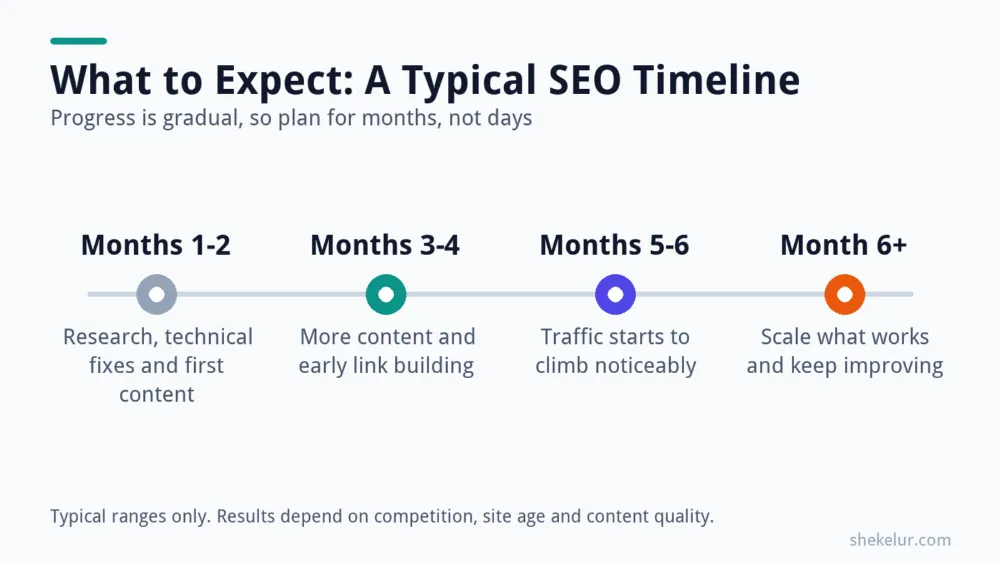
Here’s a sample timeline for a new SEO strategy:
| Month | Main Activities | Expected Results |
|---|---|---|
| 1-2 | Research, planning, fixing technical issues, creating first content | Little change in traffic |
| 3-4 | Publishing more content, starting link building | Some keywords start to rank |
| 5-6 | Improving top pages, ongoing content, more links | Noticeable traffic increase |
| 6+ | Scaling up, optimizing based on data | Steady growth, possible top rankings |
Important: SEO is a marathon, not a sprint. If you want instant results, consider paid ads, but for long-term traffic, stay consistent with your SEO plan.
Common SEO Pitfalls and How to Avoid Them
No matter how good your plan is, mistakes can happen. Here are some traps to watch for:
- Chasing only high-volume keywords: These are often too competitive. Mix in easier, long-tail keywords.
- Ignoring mobile users: Always check your site on phones and tablets.
- Publishing thin content: Every page should provide real value.
- Not updating old pages: Refresh your top content every 6-12 months.
- Neglecting technical basics: Broken links, slow speed, or poor structure can block success.
- Expecting quick wins: It often takes 3-6 months to see real change.
Bringing It All Together
Building an SEO strategy from scratch is a process, but it’s not magic. You need clear goals, solid research, great content, and ongoing measurement. Don’t chase shortcuts—focus on giving real value, and the rankings will follow. Even if you’re starting small, you can compete and win traffic if you stay consistent and keep learning.
New to SEO? Start with our SEO guide for beginners for the basics, then come back to this plan.
If you need more in-depth resources, check out the official Google SEO Starter Guide for the latest best practices.
Your Next Step: Put Your Plan Into Action
A good plan works only when you act on it. Start with your goals and keywords this week, publish your first helpful page, and review your numbers every month. If you would rather have an expert audit your site or write content for you, you can browse vetted freelancers and compare reviews first.
Frequently Asked Questions
How Do I Start an SEO Strategy from Scratch?
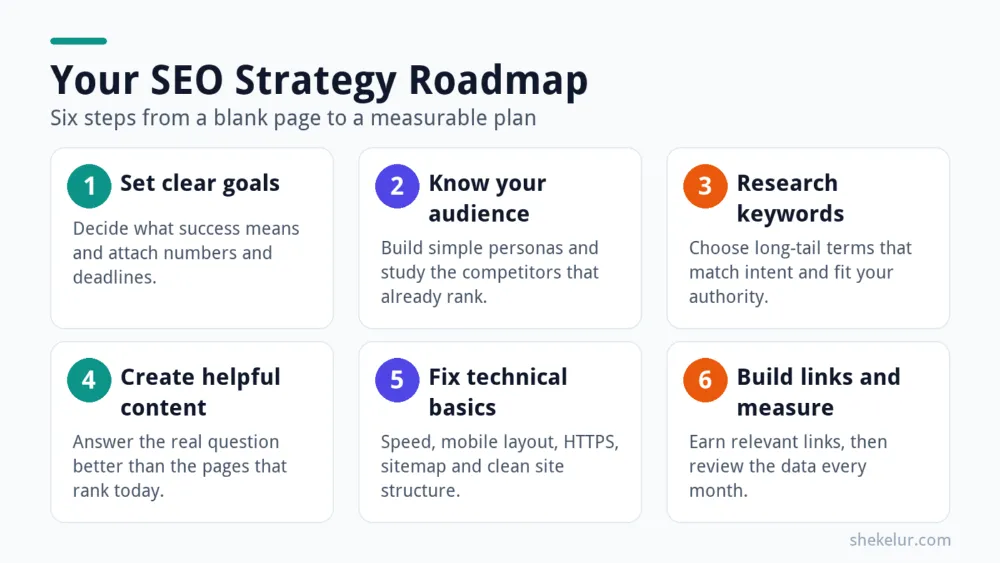
Start your SEO strategy from scratch by setting measurable goals, researching your audience and keywords, and publishing helpful content on a technically sound website. Review your data every month and improve what works. The roadmap near the top of this guide shows the order.
What Is the Difference Between SEO and Paid Ads?
SEO focuses on getting free, organic traffic from search engines by improving your site’s quality and relevance. Paid ads (like Google Ads) let you buy spots at the top of search results, but you pay for every click. SEO takes longer but can bring more sustainable traffic.
How Long Does It Take to See Results from SEO?
Most websites start seeing noticeable SEO results within 3-6 months, but it depends on competition, your efforts, and your site’s starting point. Some improvements (like fixing technical errors) can help quickly, but ranking for competitive keywords takes longer.
Can I Do SEO Myself, or Do I Need to Hire an Expert?
Many beginners start by doing SEO themselves and get good results, especially with free resources and tools. If you have more complex needs, or limited time, hiring an expert can speed up the process and help avoid mistakes.
What Are the Most Important SEO Ranking Factors?
Key factors include quality content, relevant keywords, user experience (site speed, mobile-friendliness), and quality backlinks. No single factor guarantees success—you need a balanced strategy covering all these areas.
Is SEO a One-Time Task or an Ongoing Process?
SEO is an ongoing process. Search engines, competitors, and user behavior all change over time. You need to update your content, monitor performance, and adapt your strategy regularly to stay ahead.
By following these steps and staying patient, you’ll build an SEO strategy that brings lasting results. Keep learning, stay consistent, and you’ll see your website grow.