Transparency Note: This post contains affiliate links. If you purchase external services through the links provided, we may earn a small commission at no additional cost to you.
Disclosure: this article contains affiliate links, including links to Fiverr and Hostinger. If you buy through them, I may earn a commission at no extra cost to you. Read my affiliate disclosure for details.
The world of search engine optimization keeps evolving, and the pace of algorithmic updates is accelerating every single year. In 2026, Google, Bing, and AI-powered answer engines are smarter than ever before. Their primary mission is to deliver the fastest, most trustworthy answers to users—which means your website must be technically and editorially ready to meet those standards.
On-page SEO is no longer just about sprinkling exact-match keywords into your paragraphs and tweaking title tags. Today, ranking on the first page is about delivering undeniable value, demonstrating real-world expertise, and structuring your web pages so both human visitors and search engine crawlers can effortlessly digest your content.
If you want your website to dominate organic search in 2026, you need to leave outdated tactics behind. This comprehensive guide walks you through the best on-page SEO practices for 2026, backed by recent industry data and search trends. Whether you plan to implement these optimizations yourself or want to save dozens of hours and hire a vetted on-page SEO specialist on Fiverr to audit and upgrade your site for you, these proven strategies will help you outrank your toughest competitors.
Understanding On-Page SEO in 2026
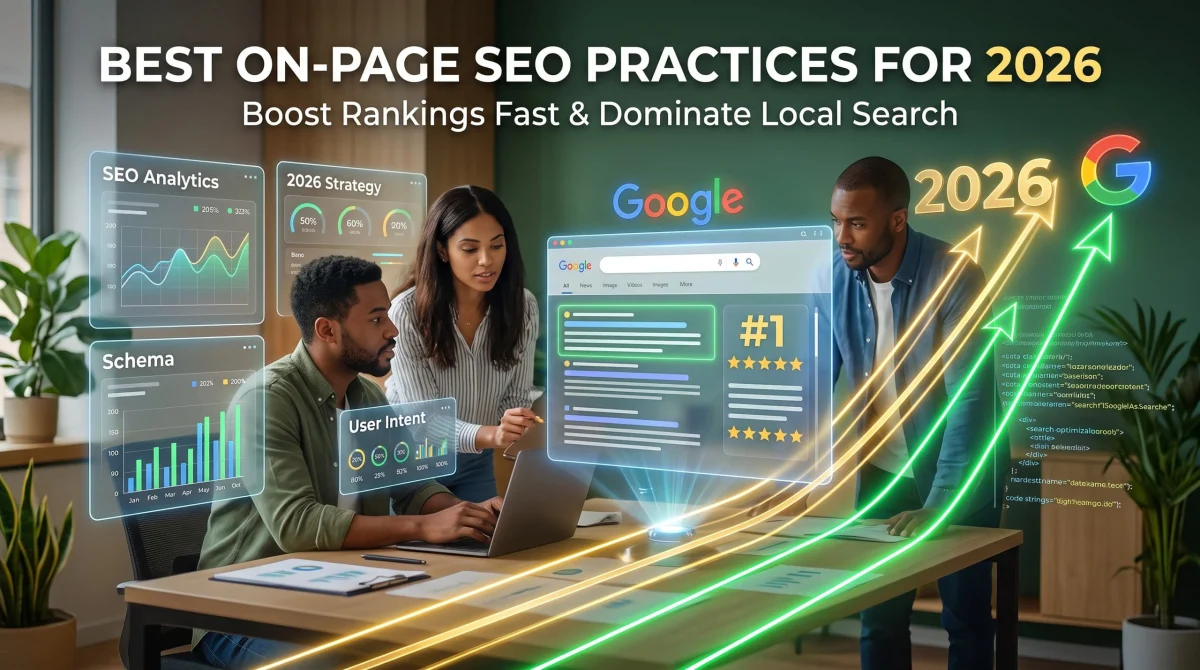
On-page SEO (also known as on-site SEO) refers to the practice of optimizing the elements directly on your own website. This encompasses your written content, HTML source tags, visual media, internal links, and overall site architecture. Unlike off-page SEO—such as backlink outreach and digital PR—you have 100% control over every on-page variable.
In 2026, search engines evaluate far more than simple keyword density. Powered by advanced machine learning models like Google’s BERT, MUM, and Gemini-integrated search systems, modern algorithms focus heavily on user experience, semantic depth, and helpfulness. As outlined in Google’s Search Essentials documentation, algorithms don’t just match isolated search strings anymore—they interpret the full context, nuance, and underlying human intent behind every query.
5 Key Shifts Shaping On-Page SEO Right Now
- AI-Driven Search & Generative Overviews: Search algorithms read and synthesize content much like humans do, rewarding pages that demonstrate clarity, original insights, and comprehensive topic depth.
- Semantic Search & Entity Connections: Search engines connect words, concepts, and recognized entities. Repeating an exact keyword ten times is far less effective than naturally covering related subtopics and context.
- Strict E-E-A-T Evaluation: Experience, Expertise, Authoritativeness, and Trustworthiness are vital. Search engines look for verifiable author credentials, first-hand testing, and transparent site ownership.
- Mobile-First Indexing & Web Accessibility: Since the vast majority of global searches happen on smartphones, sites must load instantly and function seamlessly across all screen sizes. Furthermore, accessibility for users with disabilities (such as screen-reader compatibility) plays a growing role in overall page quality.
- User Engagement & Satisfaction Signals: Metrics like dwell time, pogo-sticking (quickly bouncing back to search results), and organic click-through rate (CTR) show algorithms whether visitors actually find your page helpful.
Crafting High-Quality, Intent-Driven Content
Compelling content remains the bedrock of on-page SEO. However, “high-quality” in 2026 does not mean churning out fluffy 5,000-word essays—it means delivering the most complete, friction-free answer to the user’s problem.
1. Master Search Intent First
Before writing a single sentence, ask yourself why someone is typing that query into Google or Bing. Are they looking to learn a concept (informational), compare software options (commercial investigation), navigate to a specific login page (navigational), or make an immediate purchase (transactional)?
- Audit your existing query performance inside Google Search Console to see what phrases currently bring impressions to your URLs.
- Analyze the current top five ranking pages for your target keyword. Are they step-by-step tutorials, comparison tables, interactive calculators, or product category pages? Match your content format directly to what searchers clearly prefer.
2. Build Deep Topical Authority
Publishing a single isolated blog post rarely moves the needle in competitive niches. Instead, cover entire topics exhaustively so search engines recognize your domain as a subject-matter authority.
- Build a central “pillar page” covering a broad core topic, supported by detailed “cluster articles” answering specific long-tail questions.
- Connect these related pages together using strategic internal links. For instance, if you operate a regional business, pair your on-page improvements with our step-by-step guide on How to Rank Your Google Business Profile on Google Maps Fast.
- Incorporate related terminology, industry synonyms, and natural subtopics throughout your copy.
3. Back Up Claims with Data and Real Examples
AI-generated fluff is everywhere, which means search engines place a massive premium on verifiable facts, real statistics, and practical walkthroughs.
- Cite concrete numbers to validate your points (for example, noting that nearly 60% of global web traffic originates from mobile devices).
- Include original screenshots, step-by-step workflows, and real-world case studies that prove you have actually tested what you are teaching.
4. Optimize Every Page for E-E-A-T
- Display clear author bios at the top or bottom of every article, complete with credentials, real headshots, and links to professional social profiles.
- Cite authoritative external sources when referencing medical, financial, or technical data.
- Display a “Last Updated” date and genuinely refresh your articles when industry facts change.
Advanced Keyword Optimization Without Stuffing
Keywords still act as the compass for your content, but how you deploy them in 2026 requires finesse and context rather than brute-force repetition.
Semantic Keyword Usage (LSI & Entities)
Modern search algorithms easily understand synonyms and conceptual relationships. Instead of awkwardly repeating “best on-page SEO practices” twenty times, weave in natural variations like “on-site optimization techniques,” “HTML tag improvements,” “search intent alignment,” and “content structure guidelines.”
Strategic Keyword Placement Checklist
Ensure your primary keyword (and its close variations) appears naturally in these six high-impact zones:
- SEO Title Tag (ideally near the beginning)
- URL Slug (short, clean, and hyphen-separated)
- First 100 Words of your introduction
- Main Headings (H1, H2, and relevant H3 subheadings)
- Meta Description (to bold matching terms in search snippets)
- Image File Names and Alt Text
Answer the Full Query Using “People Also Ask”
Search engines reward pages that prevent users from having to hit the “Back” button to look for missing details. Search your target keyword on Google, inspect the “People Also Ask” (PAA) box, and address those exact follow-up questions directly inside your article’s subheadings or FAQ section.
Optimizing Title Tags and Meta Descriptions for High CTR
Your title tag and meta description serve as your website’s digital billboard on the search engine results page (SERP). Even if you rank #3, a magnetic title can help you steal clicks away from the #1 spot.
Writing High-Converting Title Tags
- Keep your title length under 60 characters (or roughly 580 pixels) so search engines don’t truncate it with an ellipsis (…).
- Place your primary keyword near the front while keeping the phrasing natural and compelling for human readers.
- Use brackets, current years, numbers, or action words to stand out (e.g., “Best On-Page SEO Practices for 2026: 12 Proven Strategies”).
Crafting Click-Worthy Meta Descriptions
- Keep descriptions under 155 characters so they display cleanly on both desktop and mobile screens.
- Summarize the exact transformation or benefit the reader will get from clicking your page.
- End with an inviting call to action (e.g., “Learn the top on-page SEO strategies for 2026. Boost your organic rankings and traffic with our step-by-step checklist.”).
| Element | On-Page SEO Best Practice | Common Ranking Mistake to Avoid |
| Keyword Position | Place primary keyword near the start of the title | Burying the main keyword at the very end |
| Title Length | Keep crisp and under 60 characters | Writing bloated titles over 70+ characters that get cut off |
| Uniqueness | Craft a 100% unique title and meta for every URL | Duplicating the same generic title across multiple pages |
| Readability | Human-friendly, benefit-driven copywriting | Robotic keyword stuffing (e.g., SEO Tips, Best SEO, On-Page SEO) |
Structuring Content with Clean Heading Hierarchy
Well-structured headings (H1 through H4) act as a roadmap for both skimming readers and search engine spiders. Walls of unbroken text drive visitors away and hurt your engagement metrics.
- Use One H1 Tag Per Page: Your H1 is your main headline and should clearly state the overarching topic of the page.
- Organize Major Sections with H2s: Use H2 tags for your primary chapters and core concepts.
- Break Down Subtopics with H3s and H4s: Nest H3 and H4 subheadings logically underneath your H2s to organize detailed steps, lists, and examples.
- Be Specific, Never Vague: Avoid lazy headings like “More Info” or “Tips.” Instead, use descriptive, keyword-rich headings like “Advanced On-Page SEO Strategies for E-Commerce Sites.”
Enhancing User Experience (UX) and Core Web Vitals
Technical user experience and on-page SEO are completely intertwined in 2026. If your website is sluggish, shifts around while loading, or clutters the screen with intrusive popups, visitors will bounce—and search engines will demote your rankings.
Passing Google’s Core Web Vitals
Google evaluates real-world user experience using three primary Core Web Vitals metrics (note that Interaction to Next Paint [INP] officially replaced First Input Delay [FID] as Google’s core responsiveness standard, though legacy tools may still reference both):
- Largest Contentful Paint (LCP): Measures how fast the main content of your page loads. Aim for under 2.5 seconds.
- Interaction to Next Paint (INP) / First Input Delay (FID): Measures how quickly your page responds when a user clicks a button or taps a menu. Aim for an INP under 200 ms (and FID under 100 ms).
- Cumulative Layout Shift (CLS): Measures visual stability so text and buttons don’t unexpectedly jump around while ads or images load. Aim for a score under 0.1.
| Core Web Vital Metric | Good Score (Target) | Needs Improvement | Poor Score (Hurts SEO) |
| LCP (Loading Speed) | Under 2.5 seconds | 2.5 – 4.0 seconds | Over 4.0 seconds |
| INP / FID (Interactivity) | < 200 ms (INP) / < 100 ms (FID) | 200 – 500 ms (INP) | Over 500 ms (INP) |
| CLS (Visual Stability) | Under 0.1 | 0.1 – 0.25 | Over 0.25 |
Note for AdSense Publishers: To protect your CLS score while running Google AdSense, always reserve fixed minimum height containers (min-height) for your ad slots so banner ads never push content downward after the page renders.
4 Actionable UX Improvements You Can Make Today
- Speed Up Your Server & Scripts: Test your URLs on Google PageSpeed Insights, minify heavy JavaScript files, enable browser caching, and use a Content Delivery Network (CDN).
- Design Mobile-First: Use responsive layouts, generous tap targets for buttons, and readable 16px+ body fonts without intrusive interstitial popups.
- Flatten Your Navigation Architecture: Use clean menus and breadcrumb trails so any important page on your website can be reached within 3 clicks or fewer from the homepage.
- Prioritize Web Accessibility: Maintain high text-to-background color contrast, ensure full keyboard navigability, and write descriptive alt tags for every visual element.
| UX Factor | Direct SEO Impact | Fast Actionable Tip |
| Page Load Speed | Higher rankings & lower bounce rates | Audit scripts using PageSpeed Insights |
| Mobile Responsiveness | Stronger mobile-first indexing performance | Test layouts across multiple smartphone viewports |
| Web Accessibility | Broader audience reach & legal compliance | Add descriptive alt text and verify keyboard navigation |
| Intuitive Navigation | Higher pages-per-session & deeper crawling | Implement clear header menus and HTML breadcrumbs |
If fixing render-blocking JavaScript, optimizing server response times, and debugging Core Web Vitals feels too technical, you don’t have to struggle through the code yourself. You can easily hire an experienced technical SEO and Core Web Vitals expert on Fiverr to speed up your site and get your PageSpeed scores into the green.
Server speed feeds into Core Web Vitals, so hosting matters too. If you suspect your server is the bottleneck, test it first, then consider moving to faster web hosting that supports caching. Check the plan details and renewal price before you switch.
Optimizing Images, Video, and Interactive Media
Visual media and interactive tools keep visitors glued to your page, dramatically boosting dwell time. However, unoptimized media files are the number one cause of slow-loading websites.
- Serve Next-Gen Image Formats: Convert heavy JPEGs and PNGs into lightweight WebP or AVIF formats, compressing them under 70 KB whenever possible without sacrificing visual crispness.
- Enable Native Lazy Loading: Add
loading="lazy"and explicitwidthandheightattributes to your images so off-screen graphics only load as the reader scrolls down. - Write Descriptive Alt Text: Help visually impaired users and image-search crawlers understand your graphics (e.g.,
alt="2026 on-page SEO checklist showing Core Web Vitals thresholds"instead ofalt="IMG_4092.jpg"). - Host Videos Externally & Add Transcripts: Embed videos from YouTube or Vimeo rather than hosting massive MP4 files directly on your web server, and always include text transcripts or key takeaways underneath for search crawlers.
- Add Lightweight Interactivity: Incorporate useful calculators, quizzes, clickable accordions, or comparison tables that encourage users to actively interact with your page.
Strategic Internal and Outbound Linking
Links form the nervous system of the internet. How you link within your own site—and out to trusted resources—directly impacts how search engines evaluate your authority.
Internal Linking Best Practices
- Connect Related Content Naturally: Whenever you publish a new post, add 3 to 5 internal links pointing to relevant existing articles, and go back to older high-traffic pages to link forward to your new post.
- Use Descriptive Anchor Text: Never use generic anchor text like “click here” or “read this post.” Instead, use natural, keyword-descriptive phrases like “explore our complete guide to local keyword research for small businesses.”
- Pass Link Equity to Money Pages: Use your informational blog posts to funnel internal link authority toward your highest-converting product, service, or affiliate review pages.
Using Outbound (External) Links Wisely
- Link to Authoritative Primary Sources: Citing respected industry leaders, official documentation, academic studies, or government portals proves your content is well-researched.
- Keep Outbound Links Focused: Aim for 1 to 4 highly relevant external links per article rather than cluttering every paragraph with outbound distractions.
- Follow Proper Link Attributes: Set external links to open in a new browser tab (
target="_blank"), and always applyrel="sponsored"orrel="nofollow"to paid placements and affiliate links to stay 100% compliant with Google’s spam policies.
Leveraging Structured Data and Schema Markup
Structured data is standardized code that translates your page’s content into a structured format that search engines and AI models can instantly categorize. Implementing vocabulary from Schema.org in JSON-LD format makes your pages eligible for eye-catching Rich Snippets in search results.
- Article Schema: Helps search engines display your headline, author name, featured image, and publication date accurately.
- FAQ Schema: Structures your question-and-answer blocks for enhanced visibility.
- Product & Review Schema: Essential for e-commerce and affiliate review posts, displaying star ratings, price ranges, and stock availability right on the SERP.
- HowTo & Video Schema: Highlights step-by-step instructions and video timestamps directly in search results.
Always validate your structured data code before publishing using Google’s official Rich Results Test tool to ensure zero syntax errors.
Monitoring, Updating, and Avoiding Common SEO Mistakes
On-page SEO is never a “set it and forget it” task. Even a #1 ranking article will eventually experience “content decay” if competitors publish fresher data.
How to Keep Your Content Fresh
- Audit Pages Every 6 to 12 Months: Review your top pages in Google Analytics and Search Console. If an article’s impressions or clicks are sliding downward, refresh outdated statistics, expand thin sections, and verify that all links still work.
- Refresh Schema & PAA Questions: Search queries evolve rapidly. Check the current “People Also Ask” results for your topic every six months and add new Q&As to keep your page comprehensive.
10 Common On-Page SEO Mistakes to Avoid in 2026
- Ignoring Search Intent: Writing a sales pitch for a keyword where users clearly want an educational tutorial.
- Keyword Stuffing: Forcing exact-match phrases into every sentence, making your writing sound unnatural and spammy.
- Publishing Thin, Unoriginal Content: Rewriting the same surface-level points as everyone else without adding unique examples or insights.
- Skipping Image Alt Text: Leaving
alt=""attributes blank and missing out on image search traffic and accessibility compliance. - Bloated Page Load Times: Uploading uncompressed 4MB photos that destroy mobile loading speed.
- Duplicate Title Tags & Meta Descriptions: Using identical titles across multiple pages, causing keyword cannibalization.
- Broken Internal Links (404s): Sending users and search crawlers to dead ends.
- Neglecting Schema Markup: Leaving rich snippet opportunities on the table for competitors to claim.
- Cluttered Mobile Layouts: Using tiny fonts or intrusive popups that frustrate smartphone readers.
- Letting Content Grow Stale: Leaving 2022 or 2023 references inside articles that claim to offer current advice.
Future-Proofing Your Website for AI and Voice Search
As conversational AI assistants, voice search, and generative search summaries become standard habits for everyday internet users, future-proofing your on-page SEO comes down to clarity and directness:
- Optimize for Conversational Queries & Featured Snippets: Include natural, question-based H2 and H3 subheadings (e.g., “What is the most important on-page SEO factor?”) followed immediately by a direct, concise 40-to-50-word answer paragraph that AI engines and voice assistants can easily extract.
- Double Down on First-Hand Experience: AI tools can summarize general facts in seconds, but they cannot replicate your personal case studies, original photography, proprietary data, or real product testing. Make human experience the centerpiece of every post.
Frequently Asked Questions (FAQs)
What is the most important on-page SEO factor in 2026?
The single most important factor is content quality aligned with search intent. Search engines want to satisfy the user on the first click. Your page must thoroughly answer the searcher’s query, demonstrate real-world E-E-A-T (Experience, Expertise, Authoritativeness, and Trustworthiness), and load quickly on mobile devices.
How often should I update my website’s existing content?
You should audit and update your core evergreen pages at least every 6 to 12 months. For fast-moving industries like technology, finance, or digital marketing, reviewing top-performing posts every 3 to 6 months helps you replace outdated stats, fix broken links, and defend your top rankings against newer competitors.
What is schema markup and why does it matter for SEO?
Schema markup (structured data) is standardized code added to your HTML that explicitly tells search engines what your content means—such as identifying a recipe, product review, FAQ, or tutorial. It makes your pages eligible for rich results (like star ratings and dropdown FAQs in search listings), which significantly boosts your organic click-through rate.
How does mobile-first indexing affect my on-page SEO?
Mobile-first indexing means Google predominantly crawls and evaluates the mobile version of your website to determine your rankings on both mobile and desktop searches. If your mobile site hides important text, loads slowly, or features broken navigation, your overall search visibility will suffer across all devices.
Can short blog posts still rank on page one in 2026?
Yes, short content can still rank if the query requires a quick, direct answer (such as a simple definition, unit conversion, or specific troubleshooting step). Word count itself is not a direct ranking factor. However, for broad or competitive keywords, detailed guides naturally perform better because they satisfy multiple angles of user intent on a single page.
Ready to Skyrocket Your Organic Traffic in 2026?
Mastering on-page SEO in 2026 requires more than old-school keyword tricks—it demands a seamless blend of intent-driven writing, clean HTML structure, lightning-fast Core Web Vitals, and genuine topical authority. By applying the practices in this guide across your most important pages, you will build a resilient, search-friendly website that attracts high-converting organic traffic on both Google and Bing for years to come.
Of course, auditing dozens of articles, writing custom JSON-LD schema markup, compressing media assets, and optimizing page speed takes serious time and technical precision. If you want to fast-track your growth without getting bogged down in technical checklists, you can connect with top-rated On-Page SEO and Technical Optimization experts on Fiverr today to get your website professionally audited, optimized, and positioned for page-one rankings.