Is parasite SEO safe for long-term SEO? In short, no. Parasite SEO can deliver quick rankings, but it relies on platforms you do not control and on search rules that keep getting stricter, so it is a risky foundation for a lasting online business.
In this guide, you will learn what parasite SEO is, why people use it, what Google’s spam policies say, and which safer options give you more control. Where possible, the advice is based on Google’s own documentation rather than guesswork.
Disclosure: this article contains affiliate links, including links to Fiverr and Hostinger. If you buy through them, I may earn a commission at no extra cost to you. Read my affiliate disclosure for details.
What Is Parasite SEO?
Parasite SEO is a technique where marketers publish content on high-authority websites that they don’t own. The goal is to rank quickly for competitive keywords by “piggybacking” on the trust and authority of these established sites. Instead of building your own website’s power over years, you use someone else’s strong domain to get traffic fast.
Here’s how it usually works:
- Someone finds a high-authority website that allows user-generated content (like articles, posts, or profiles).
- They create keyword-focused content and publish it on that platform.
- The content ranks in Google because the host site is already trusted.
- Traffic is sent to the parasite page, often with links or CTAs pointing toward the marketer’s own site, offers, or products.
Examples of popular platforms used for parasite SEO:
- Medium
- LinkedIn Pulse
- Quora
- Public news or press release sites
These platforms have strong domain authority, which helps new content rank faster than it would on a brand-new website.
Why Do People Use Parasite SEO?
The main appeal of parasite SEO is speed. Building your own website’s SEO power can take months or years. With parasite SEO, you can sometimes get a page to rank on the first page of Google within days—especially for trending or low-competition keywords.
Other reasons marketers like parasite SEO:
- Lower costs: No need to build or maintain your own site.
- Easy backlinks: The host site’s authority acts as a natural backlink.
- Skipping the slow start: New sites often take months to earn visibility, while pages on established domains can get indexed quickly.
But these short-term wins can come with long-term dangers. Let’s look at why.
How Parasite SEO Differs from Traditional SEO
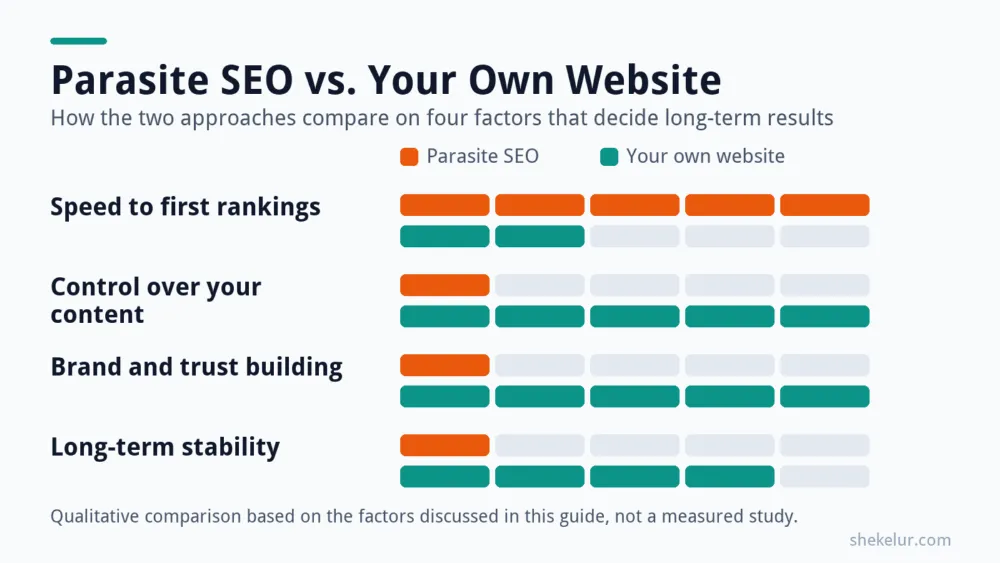
To understand the risks, it helps to compare parasite SEO with standard methods. Here’s a quick breakdown:
| Parasite SEO | Traditional SEO |
|---|---|
| Uses third-party sites for publishing | Uses your own website |
| Rides on host site’s domain authority | Builds your own domain authority |
| Faster initial rankings | Slower, gradual rankings |
| Risk of losing control/content removal | Full control of content and strategy |
| Often seen as a “grey hat” tactic | Considered “white hat” best practice |
Parasite SEO is about using shortcuts. Traditional SEO is about building a long-term asset. Both approaches can bring traffic, but the risks and rewards are very different.
The Short-Term Benefits of Parasite SEO
There’s a reason why parasite SEO has become popular among growth hackers and affiliate marketers. The method can bring quick wins, especially if you need to test offers or get instant visibility.
- Quick Rankings: Since platforms like Medium or Reddit already have high trust, Google may index and rank your content in a matter of days.
- Low Investment: You don’t need to spend money on hosting, web design, or technical SEO.
- Testing Power: You can test keywords and offers before investing in a full website.
A typical example: a marketer publishes a detailed guide on a trusted platform and ranks for a medium-difficulty keyword within days. That can bring a burst of visits sooner than a new site could earn them. For a current look at how well this works, read Is parasite SEO still effective in 2026?
However, fast results don’t always last.
The Long-Term Risks of Parasite SEO
So, is parasite SEO safe for long-term SEO? If you are focused on long-term safety, the tactic starts to look much less attractive. Here is why many SEO professionals caution against relying on it as your main strategy:
1. Lack of Control
You don’t own the platform. If the host site changes its rules, deletes your content, or bans your account, all your work can disappear overnight. This has happened to many marketers—sometimes after months of effort.
2. Content Removal and Moderation
Most high-authority sites have strict guidelines. If your content is seen as spammy, promotional, or low-quality, it can be removed without warning. Even a single complaint from another user can trigger a takedown.
3. Short-Lived Rankings
Search engines update their algorithms regularly. A parasite page that ranks today may be deindexed tomorrow. In fact, Google sometimes targets parasite SEO specifically, downgrading or removing these pages from results.
For example, Google announced its site reputation abuse policy in March 2024 and began enforcing it in May 2024, which targeted exactly the kind of third-party pages parasite SEO relies on.
4. Weak Brand Building
Since visitors land on someone else’s site, it’s hard to build your own brand trust. Most readers remember the host site (like Medium) more than your business. This limits customer loyalty and repeat traffic.
5. Unstable Revenue
If you rely on parasite SEO for affiliate sales or lead generation, income can vanish if your pages are taken down. There’s no guarantee of stability.
6. Legal and Ethical Issues
Some platforms have strict terms of service. If you break these—intentionally or not—you could face legal action or a permanent ban. Search engines may also consider parasite SEO a “grey hat” or even “black hat” tactic, which can lead to penalties.
Google’s View on Parasite SEO
Google has made its position clear: it wants helpful, original content created for people, not tricks that game the rankings. Its spam policies include a rule against site reputation abuse, which is the practice most closely linked to parasite SEO.
Here is how the policy developed:
- March 2024: Google announced the policy alongside a core update and a spam update. Read the announcement on Google Search Central.
- May 2024: Enforcement began, and several large news sites saw sections of their websites lose visibility, as covered by Search Engine Land.
- November 2024: Google clarified that third-party content used to exploit a host site’s ranking signals can violate the policy even when the host is involved in producing it. See the official update.
Google also stresses that not all third-party content violates the policy, and its spam policies page explains what does and does not count. The practical takeaway is simple: the policy targets hosts, but if your strategy depends on pages that rank because of someone else’s domain, those pages can lose visibility or disappear when the host cleans up.
When Parasite SEO Can Be Useful
Despite the risks, parasite SEO isn’t always bad. In some cases, it can be a useful tool—if you understand its limits.
- Launching a new product: Use parasite SEO to get quick feedback or traffic while you build your main site.
- Testing markets: Try out different keywords or offers before investing in a full campaign.
- Supporting traditional SEO: Drive extra traffic from multiple sources (but don’t rely on it as your main channel).
Even then, you should treat parasite SEO as a short-term tactic, not a core strategy.
What Can Go Wrong: Three Realistic Scenarios
These are composite scenarios based on how the tactic commonly plays out. They are not specific named cases, and they make no earnings claims.
Scenario 1: A Fast Win That Disappears
A marketer publishes a product comparison on a high-authority platform and ranks within days. Weeks later, the page is removed in a moderation sweep, and the traffic and affiliate income attached to it vanish. With nothing built on their own domain, there is nothing to fall back on.
Scenario 2: Testing Ideas Before Investing
A founder publishes short guides on several topics to see which ones attract readers. The winners then become full, original articles on the founder’s own site. The third-party pages are treated as disposable research, not as a source of income.
Scenario 3: The Host Gets Hit
After enforcement began in 2024, several large publishers lost visibility for sections that hosted third-party content, according to Search Engine Land. The lesson is that the risk reaches the host site and everyone who relies on those pages.
Comparing Parasite SEO with Other Link-Building Methods
Let’s see how parasite SEO stacks up against other common link-building and content promotion tactics.
| Strategy | Speed | Long-Term Control | Branding | Google Risk |
|---|---|---|---|---|
| Parasite SEO | Very Fast | Low | Weak | High |
| Guest Posting | Medium | Medium | Medium | Low-Medium |
| Traditional SEO | Slow | High | Strong | Low |
| Private Blog Networks (PBNs) | Fast | Low | Weak | Very High |
Parasite SEO is fast but risky. Guest posting and traditional SEO are safer for building a long-term brand and online presence.
Common Mistakes with Parasite SEO
Many beginners fall into traps when trying parasite SEO. Here are mistakes to avoid:
- Overusing one platform: If you put all your content on a single site, a ban or rule change wipes out everything.
- Ignoring quality: Low-value, spammy content is quickly removed. High-authority sites and search engines both demand quality.
- No backup plan: Many rely on parasite SEO alone and don’t invest in their own website.
- Breaking rules: Not reading the platform’s terms can lead to fast bans.
- Chasing trends: Jumping on the latest loophole can work for a few weeks, but often backfires after Google updates.
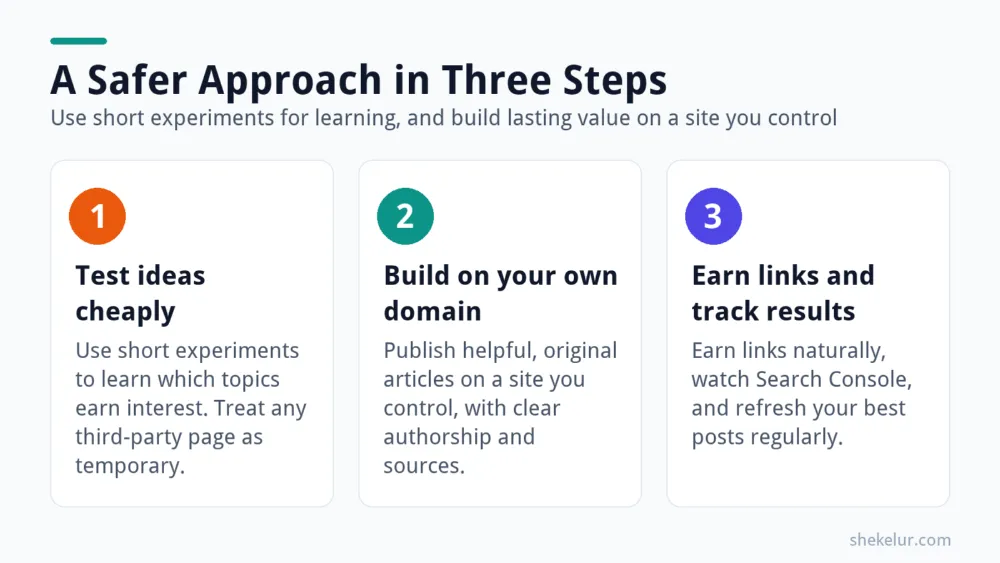
The safest approach: Use parasite SEO for temporary experiments, and focus your main effort on building assets you control.
Best Practices for Safe Use (If You Still Want to Try)
If you decide to use parasite SEO, these steps can reduce your risk:
- Diversify platforms: Don’t rely on just one third-party site.
- Follow guidelines: Read and respect the host site’s rules and content policies.
- Focus on value: Write useful, well-researched content—not just sales pages.
- Build your own site: Use parasite SEO as a supplement, not a replacement.
- Track changes: Monitor rankings and be ready to adapt if Google updates algorithms.
- Don’t over-optimize: Too many exact match keywords or spammy links can trigger penalties.
Need a hand building on your own site? You can compare independent freelancers for SEO audits, content writing and technical fixes on Fiverr. Check reviews and sample work first, and avoid any seller who promises guaranteed rankings or sells bulk backlinks, since those tactics can break Google’s link spam rules.
Non-Obvious Insights
Two points most beginners miss:
- The risk is shared: Google’s policy targets the hosting site, so platforms may tighten their moderation, and your pages can be affected when they do.
- Brand searches last: People who find you on someone else’s domain remember that brand, not yours. Traffic from searches for your own brand is the kind no policy change can take away.
Is Parasite SEO Ever White Hat?
Some marketers argue that parasite SEO can be “white hat” if the content is valuable and follows all guidelines. For example, publishing an expert guide on Medium that genuinely helps readers. The difference comes down to intent and quality.
But even white hat parasite SEO is vulnerable to sudden changes—because you don’t control the platform or Google’s algorithms. For most brands, investing in their own site is the safer path.
Alternatives to Parasite SEO
If you want fast traffic and rankings, but worry about the risks, here are some alternatives:
- Guest posting: Publish high-quality content on reputable blogs with your name attached.
- Digital PR: Get featured in news stories or interviews.
- Content syndication: Republish selected articles elsewhere only with a link or canonical reference back to your original.
- Social media marketing: Use platforms like Twitter, LinkedIn, or Reddit for quick exposure.
These methods build real authority and relationships, not just temporary rankings.
Related reading: learn the fundamentals in on-page SEO for new websites, apply the best on-page SEO practices for 2026, and see how this tactic performs today in Is parasite SEO still effective in 2026?.
The safest alternative is also the most durable: a site you own. You can start with hosting for your own website, publish helpful pages and build trust over time. Compare plan features, the billing term and the renewal price before you buy.
Final Thoughts: Is Parasite SEO Safe for Long-Term SEO?
Parasite SEO can deliver fast results, especially if you need instant traffic or want to test ideas. But for long-term SEO safety, it’s a risky strategy. You don’t control the platform, your content can be deleted at any time, and Google is actively cracking down on these tactics.
If your goal is to build a stable brand, reliable search rankings, and lasting income, focus on traditional SEO and content marketing on your own site. Use parasite SEO only as a short-term experiment—not as the foundation of your business.
So, is parasite SEO safe? Only as a short-term experiment, never as the foundation of a business. If you are starting from zero, our guide on how to build an SEO strategy from scratch shows the order to work in, and the SEO guide for beginners covers the basics step by step.
To read the source material, see Google’s site reputation abuse update and its spam policies for web search.
Build the site you own
Parasite SEO rents someone else’s audience. A site on your own hosting is an asset you control. Hostinger offers shared, cloud and VPS plans, so you can start small and upgrade as you grow.
See Hostinger hosting plansAffiliate link. It opens your cart with a plan preselected, so you can change the plan, billing term and add-ons before you pay. Check the renewal price too.
Your Next Step: Build Something You Own
The safest long-term plan is a website you own, with helpful articles, clear authorship and sources. If you want expert support while you build it, a vetted freelancer can handle the audit, the writing or the technical fixes so you can focus on your business.
Frequently Asked Questions
Is Parasite SEO Safe for My Website?
Parasite pages sit on other people’s domains, so they usually do not harm your main site directly. The risk is to your results: the pages can be removed or lose rankings at any time. It is safer to use your own website as the foundation and treat third-party pages as short experiments.
What Is Parasite SEO in Simple Words?
Parasite SEO is when you publish content on big, trusted websites you don’t own, hoping to rank quickly in Google using their authority. It’s like “borrowing” their reputation to get your page seen.
Is Parasite SEO Illegal?
No, parasite SEO is not illegal. But it can break the rules of the host site, and Google may see it as a way to manipulate search results. This can lead to content removal, bans, or lower rankings.
How Long Do Parasite SEO Pages Usually Rank?
There is no fixed answer. Some pages hold their rankings for a while, while others disappear quickly after a policy update or a moderation sweep. Because you do not control the host, you cannot plan around how long they will last.
Can Parasite SEO Hurt My Main Website?
Usually, parasite SEO pages are separate from your main site. But if you link too aggressively or use spammy tactics, your main site could be affected—especially if Google links the two.
Are There Safer Alternatives to Parasite SEO?
Yes. Safer options include guest posting, digital PR, and building your own site’s authority with quality content. These methods take more time but offer more control and long-term benefits.