Claude Vs Chatgpt For Content Writing
If you write for the web, you’ve likely heard about Claude and ChatGPT. Both are powerful AI tools for creating content, but they each have their own strengths, weaknesses, and quirks. Choosing the right one can make a big difference in your productivity and the quality of your articles, blog posts, or marketing copy. In this guide, we’ll explore how Claude and ChatGPT compare for content writing, what you can expect from each, and where they stand out—or fall short. By the end, you’ll have a clear idea of which AI might be the best fit for your needs.
What Are Claude And Chatgpt?
Claude and ChatGPT are both advanced AI language models designed to understand and generate human-like text. Claude is developed by Anthropic, while ChatGPT is created by OpenAI. Both use deep learning and have been trained on massive amounts of text from the internet, books, and other sources.
But their approaches are not the same. Claude focuses on safety, helpfulness, and reducing bias. ChatGPT aims to be general-purpose, offering a wide range of writing styles and use cases. While both can write articles, emails, stories, and more, they sometimes produce different results depending on your prompt and goals.
Core Features And Capabilities
To understand how Claude and ChatGPT perform for content writing, it’s useful to look at their main features and what makes each unique.
| Feature | Claude | ChatGPT |
|---|---|---|
| Developer | Anthropic | OpenAI |
| Model Size | Claude 2/Claude 3 (various sizes) | GPT-3.5, GPT-4 |
| Safety Controls | Very strong | Strong, but more flexible |
| Customization | Limited | High (with plugins, API, fine-tuning) |
| Content Types | General writing, summaries, Q&A | Wide range: blogs, code, stories, essays |
| Language Support | English (strong), limited other languages | English (strong), many other languages |
| Pricing | Subscription or API | Free (basic), Plus (paid), API |
Both tools can produce high-quality English content. However, some key differences affect the writing process and results.
Writing Quality: How Do They Compare?
Claude’s Writing Style
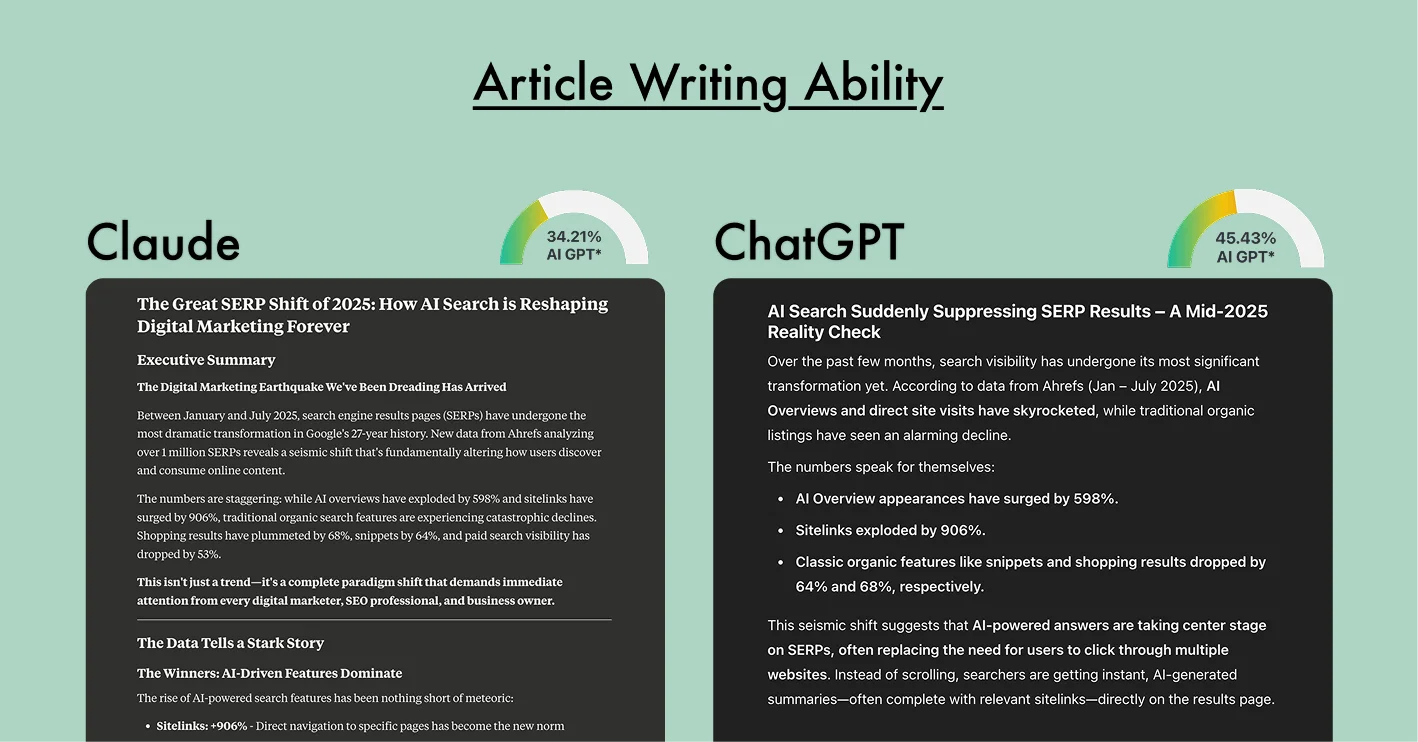
Claude is known for its balanced tone and careful language. It tends to write in a way that’s clear, polite, and easy to read. For web content, this is useful if you need articles that sound professional and neutral. Claude rarely uses slang, strong opinions, or risky humor—making it a safe choice for brands or formal publications.
One non-obvious strength is that Claude often catches subtle ethical issues or sensitive topics and responds thoughtfully. For example, if you ask Claude to write about health or finance, it often adds gentle disclaimers or encourages readers to seek expert advice. This can help you avoid publishing content that might be flagged for misinformation or insensitivity.
Chatgpt’s Writing Style
ChatGPT is more flexible and creative. It can mimic different tones—from friendly and playful to formal and technical. If you need a unique voice or want to experiment with storytelling, ChatGPT has an edge. It also handles humor and cultural references more smoothly.
However, with this flexibility comes risk. ChatGPT can sometimes generate factual errors (often called “hallucinations”) or invent details if your prompt is unclear. It’s important to review its output, especially for topics that require accuracy. But for creative writing, brainstorming, or casual blog posts, ChatGPT often feels more lively and “human.”
Speed And Efficiency
AI tools are popular because they save time—but there are differences in speed and workflow.
- Claude responds quickly, often with concise and on-topic answers.
- ChatGPT is also fast, but may produce longer responses, sometimes adding details or examples you didn’t request.
For long-form content, ChatGPT’s tendency to elaborate can be useful. But if you need short, direct answers or summaries, Claude might save you editing time.
Handling Different Types Of Content
Both Claude and ChatGPT can write many kinds of content. Here’s how they perform in some common writing tasks:
Blog Posts
- ChatGPT often delivers more engaging, detailed blog drafts. It can expand simple ideas into full sections and add examples or analogies.
- Claude writes clearly and stays on topic. Its blog posts are usually more neutral, with fewer surprises but also fewer errors.
Product Descriptions
- Claude creates safe, professional descriptions, ideal for corporate or official sites.
- ChatGPT can add persuasive language, storytelling, or humor—useful for e-commerce or marketing.
Technical Writing
- Claude is careful with instructions and tends to avoid over-promising. It’s good for documentation or help articles.
- ChatGPT can explain complex topics with creative metaphors or step-by-step guides, but sometimes invents details.
Summaries
- Both do well, but Claude excels at concise, fact-based summaries.
Creative Content
- ChatGPT is stronger in poetry, stories, and brainstorming sessions.
Customization And Control
Advanced users sometimes want to shape the AI’s behavior or output style.
- ChatGPT offers plugins, API access, and some fine-tuning options. You can adjust its instructions, train it on your data, or use it inside other tools.
- Claude is less customizable, focusing on safety and consistent behavior. It’s harder to “break out” of its polite style, but you get reliable results.
For most everyday writers, these differences may not matter. But if you need to build a custom workflow or automate content at scale, ChatGPT has more tools available.
Safety And Reliability
AI-generated content can have risks: bias, misinformation, or inappropriate language.
- Claude has very strong safety rules. It tries to avoid controversial or sensitive topics unless you ask directly. This makes it a safer choice for schools, businesses, or regulated industries.
- ChatGPT is safer than earlier AI models, but sometimes takes more risks in its answers. You may need to check for bias or unwanted opinions, especially on sensitive subjects.
Both tools have improved over time, but Claude’s safety-first design is clear. If you’re concerned about publishing something risky, Claude is often the safer bet.
Accuracy And Fact-checking
A major challenge with AI writing is hallucination—when the AI makes up facts or quotes.
- Claude is less likely to invent information, but it can still be vague or cautious if it doesn’t know the answer.
- ChatGPT is more likely to “fill in the gaps,” which is useful for creative writing but dangerous for factual topics.
Neither model is perfect. Always check facts, especially for statistics, health, law, or science content. For example, if you ask for the population of a city, both might guess unless trained on recent data.

Language Support
If you write in English, both tools perform well. For other languages:
- ChatGPT supports many languages, though quality varies.
- Claude focuses on English and may struggle with less common languages or non-standard dialects.
For global content or translation tasks, ChatGPT has a clear advantage.
User Experience And Interfaces
How you use each tool also affects the writing process.
- ChatGPT has a popular web interface, browser plugins, mobile apps, and API access. It’s easy to use for beginners and integrates with many tools.
- Claude is usually accessed through partners (like Notion or Slack), web demos, or its API. Some users find its interface less polished, but it’s improving.
If you want one-click access and many integrations, ChatGPT is currently ahead.
Pricing And Availability
Both tools have free and paid options, but details differ.
| Plan | Claude | ChatGPT |
|---|---|---|
| Free Tier | Limited trials, some free access via partners | Free (GPT-3.5 model) |
| Paid | Subscription or API usage fees | Plus plan ($20/month for GPT-4), API pricing |
| Enterprise | Contact sales | ChatGPT Team/Enterprise plans |
ChatGPT is easier to try for free, while Claude often requires an invite or partner app. For heavy users or teams, both offer paid options.
Real-world Examples
Let’s look at two short examples—a product description and a blog intro—to show how each AI handles the same task.
Prompt: “Write a short product description for a new smartwatch.”
Claude’s output:
“This advanced smartwatch features a sleek design, long battery life, and health tracking. Stay connected with notifications and monitor your fitness goals easily. Compatible with both iOS and Android devices. “
ChatGPT’s output:
“Meet the future of wearable tech—a stylish smartwatch that blends elegance with innovation. Track your health metrics, get real-time notifications, and enjoy up to 7 days of battery life. Ready for any lifestyle, it pairs perfectly with your smartphone. “
Notice how Claude is straightforward and neutral, while ChatGPT adds more personality and marketing flair.
Prompt: “Write a blog post intro about the benefits of remote work.”
Claude’s output:
“Remote work has become increasingly popular in recent years. It offers flexibility, reduces commuting time, and can improve work-life balance. Many companies now offer remote options to support their employees. “
ChatGPT’s output:
“Imagine starting your workday without a long commute or office distractions. Remote work is reshaping how we live and work, offering new levels of freedom, productivity, and balance. Let’s explore why more people are embracing this flexible way to work.
“
Again, ChatGPT creates a more engaging scene, while Claude focuses on clear, factual statements.
Strengths And Weaknesses
No AI is perfect. Here’s a summary of what each does best—and where each falls short.
Claude
Strengths
- Very safe and reliable
- Clear, polite, neutral writing
- Good at summaries and fact-based content
- Less likely to generate risky or biased content
Weaknesses
- Less creative or flexible in style
- Limited language support
- Fewer customization options
- Sometimes overly cautious
Chatgpt
Strengths
- Highly creative and adaptable
- Many writing styles and tones
- Good at storytelling and brainstorming
- Wide language support and integrations
Weaknesses
- Sometimes invents facts (“hallucination”)
- Needs more fact-checking
- Can generate risky or biased content if not guided
- More editing required for formal or sensitive topics
When To Choose Claude Over Chatgpt
Claude is a better choice if you:
- Need safe, reliable, and neutral content (e.g., for businesses, schools, or official sites)
- Write mostly in English
- Prioritize ethics, accuracy, and clear language
- Want short, direct answers or summaries
When To Choose Chatgpt Over Claude
ChatGPT is the best option if you:
- Want more creative, engaging, or varied writing
- Need support for multiple languages
- Prefer flexibility and customization (plugins, API, integrations)
- Enjoy experimenting with tone, style, or content type
Non-obvious Insights For Content Writers
- Prompt Length Matters: Both Claude and ChatGPT give better results with clear, detailed prompts. If your request is vague, ChatGPT may “guess” what you want, while Claude may be overly cautious or generic.
- Review for Subtle Bias: Even with strong safety controls, both models can reflect biases from their training data. For sensitive topics (gender, race, politics), review output carefully before publishing.
- Use for Outlining: Both AIs excel at outlining articles or suggesting structure. Let them build your outline, then fill in details yourself or ask for section drafts.
- Combine Both Tools: Some writers use Claude for summaries and fact-based sections, then ChatGPT for intros, conclusions, or creative angles. You’re not limited to just one tool.
Common Mistakes To Avoid
- Relying on AI output without editing. Always review for accuracy, tone, and clarity.
- Using vague prompts. Be specific about style, audience, and format.
- Ignoring copyright or plagiarism risks. Both models generate original content but can sometimes echo popular phrases or ideas. Use plagiarism checkers for important work.
- Assuming “AI knows everything.” Both tools have limits. For up-to-date news or niche topics, supplement with your own research.
Future Trends: What’s Next For Ai Content Writing?
Both Claude and ChatGPT are improving fast. Expect better fact-checking, more customization, and stronger tools for teams. Multimodal AIs (that handle images, audio, and video) are also coming. Soon, content creators may use a mix of AIs—each for a different purpose.
For now, the best writers are those who know how to guide, review, and adapt AI output. If you stay curious and keep learning, these tools can make you more productive and creative.
Frequently Asked Questions
What Is The Main Difference Between Claude And Chatgpt For Content Writing?
The main difference is style and safety. Claude writes in a clear, neutral, and safe tone, making it ideal for formal or sensitive content. ChatGPT is more creative and flexible, suitable for storytelling or casual blogs.
Which Ai Is Better For Non-english Content?
ChatGPT supports more languages and is generally better for writing or translating non-English content. Claude focuses mainly on English.
Is Ai-generated Content Safe For Seo?
Most AI content is fine for SEO if it’s original, useful, and well-edited. Avoid copying large sections from AI without review. Google values quality and relevance over the writing method. For more, see Google Search Guidance.
How Can I Reduce Errors Or “hallucinations” In Ai Writing?
Use detailed prompts, check facts manually, and edit the output. For important topics, ask for sources or references and verify them.
Can I Use Both Claude And Chatgpt Together?
Yes! Many writers use both. For example, Claude for summaries or safe content, ChatGPT for creative sections. Mixing tools helps you get the best of both worlds.
AI writing tools are changing fast. Whether you pick Claude, ChatGPT, or both, the key is understanding their strengths, reviewing their output, and using your own judgment as a writer. With practice, you’ll find the perfect balance for your content needs.